
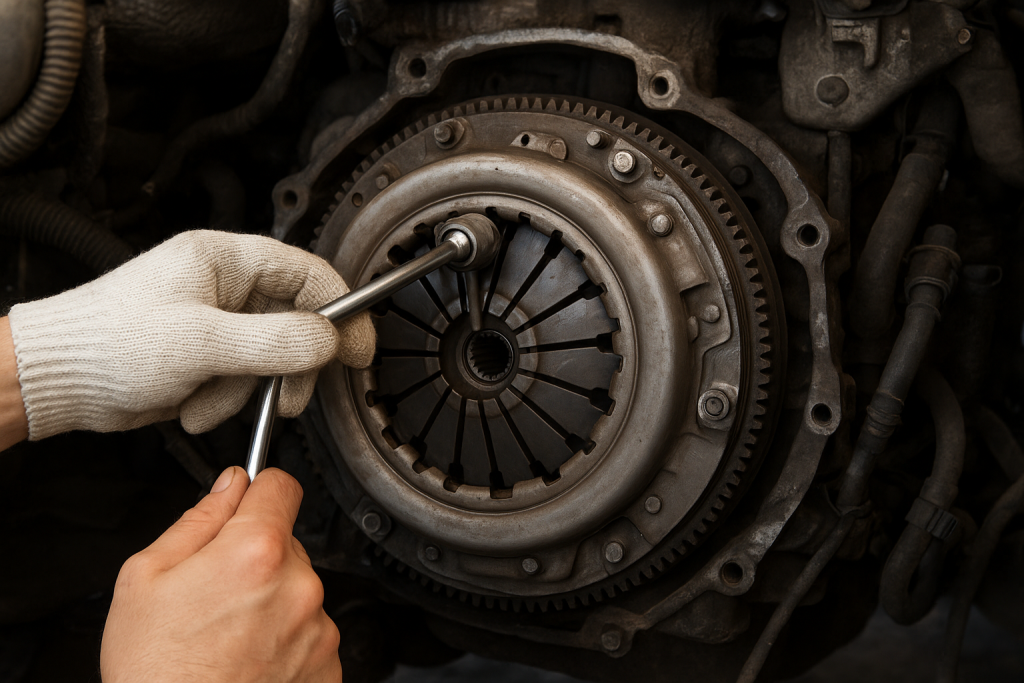
If your clutch feels different underneath your foot, it could be going bad. How long your clutch lasts depends on several factors. Some clutches only last 30,000 miles to 50,000 miles, while others last well beyond 100,000 miles. Scotty’s Automotive lists the signs that your clutch is going bad below.
Acceleration Hesitation
One sign that your clutch is having difficulties is hesitation when you press down on the accelerator. It may be that the clutch has not fully engaged, and, as such, your vehicle is not getting any power to the wheels. If your vehicle does hesitate every time you try to accelerate it, you should have it checked out because it could be a problem with the clutch, a clogged filter, or fuel system trouble.
Burning Odors
If the interior mechanisms of your clutch are wearing down, you may smell burning odors when you use the clutch. This is a sign that the clutch is slipping, and your vehicle may slip out of gear as well. Any burning odors that you smell coming from your automobile need to be looked into immediately as they can be a dangerous sign of fire.
Gear Change Difficulty
If you are having difficulty getting your manual transmission into gear, this is definitely a sign that your clutch is going bad. You may also have problems shifting through the gear cycle, and this can be attributed to a slipping clutch or a worn-out clutch. Putting your vehicle into gear and shifting through the gear cycle should never be difficult.
Grinding Gears
You may have ground the gears when you first learned to drive a manual transmission, but if you are used to your clutch now, you shouldn’t hear any grinding gears. This is a sign that the clutch is wearing out and needs to be adjusted or replaced. Changing gears should be silent and seamless.
High Catch Point
Another sign that your clutch is wearing out is changing in the catch point. You may notice that the place where your clutch catches is much higher than it used to be. Sometimes, adjusting the clutch can resolve this issue. Other times, the clutch needs to be replaced.
Spongy Feeling
Finally, if your clutch feels soft or spongy underneath your foot, this is definitely a sign that it needs to be replaced. It may also make squeaking noises as you engage and disengage it, and it may also rattle when you aren’t using it.
Scotty’s Automotive in Montague, NJ, can inspect your vehicle’s clutch to see if it needs to be adjusted or replaced. Call us today to set up an appointment.
FAQs
1. Why does my clutch feel different than usual?
A change in clutch feel, like a spongy or stiff pedal, could indicate wear, slipping, hydraulic issues, or air in the clutch lines. It’s best to have it inspected to avoid further damage.
2. What are the signs that my clutch is going bad?
Common signs include:
- Acceleration hesitation
- Burning odors
- Gear shifting difficulty
- Grinding gears
- High catch point
- A soft or spongy pedal feel
3. How long does a clutch usually last?
A clutch typically lasts between 30,000 and 100,000 miles, depending on driving habits, road conditions, and vehicle type.
4. Is it normal to smell burning when using the clutch?
No. A burning smell can indicate a slipping clutch or internal wear and should be checked immediately to prevent further damage.
5. Why is it hard to shift gears in my manual transmission car?
Difficulty shifting gears often points to a worn or misadjusted clutch. Other causes could include transmission fluid issues or worn synchros.
6. What does a high clutch catch point mean?
A higher catch point often means the clutch is wearing out. It may be resolved by an adjustment, but in many cases, it indicates the need for a clutch replacement.
7. Why does my clutch pedal feel soft or spongy?
A soft clutch pedal can be caused by air in the hydraulic system, a failing clutch master/slave cylinder, or overall clutch wear.
8. Is it bad to drive with a slipping clutch?
Yes. Driving with a slipping clutch can lead to increased wear, overheating, and eventual total clutch failure, which can leave you stranded.
9. How much does clutch replacement usually cost?
In the U.S., clutch replacement typically costs between $800 and $1,500, depending on the vehicle make/model and labor rates.
10. Can a clutch be adjusted instead of replaced?
Some older or cable-operated clutches can be adjusted. However, most modern hydraulic clutches will require replacement if they are worn out.
11. What causes a clutch to wear out quickly?
Aggressive driving, frequent stop-and-go traffic, riding the clutch, and towing heavy loads can all shorten clutch life.
12. What is the difference between a clutch slipping and sticking?
A sticking clutch doesn’t fully disengage, making it hard to shift gears or stop the car without stalling.
A slipping clutch fails to transmit full engine power, often causing poor acceleration and burning smells.
Share:
- Share on Facebook (Opens in new window) Facebook
- Share on X (Opens in new window) X
- Share on LinkedIn (Opens in new window) LinkedIn
- Share on Pinterest (Opens in new window) Pinterest
- Share on Threads (Opens in new window) Threads
- Share on Nextdoor (Opens in new window) Nextdoor
- Share on Reddit (Opens in new window) Reddit
- Share on Bluesky (Opens in new window) Bluesky
- Share on WhatsApp (Opens in new window) WhatsApp
- Share on Telegram (Opens in new window) Telegram
- Email a link to a friend (Opens in new window) Email