
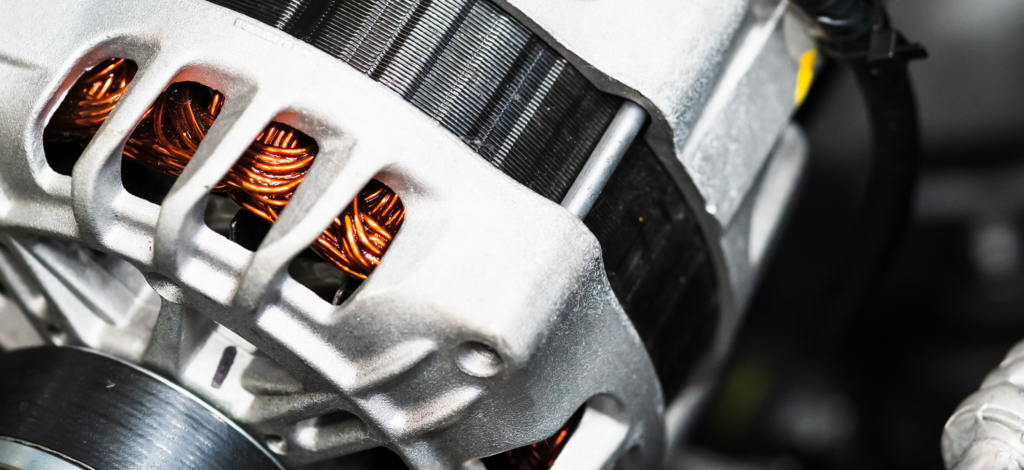
You flip a light switch, start your car, or charge your phone without giving it much thought. Electrical power generation makes all these things possible, behind the scenes in your daily life and in factories around the globe. From the automobile in your driveway to massive power plants that supply entire cities, mechanical energy translated into electrical energy is what runs your modern world. Two units perform this critical function: alternators and generators. They are both the conversion of electrical energy from mechanical energy through electromagnetic induction, but everyone uses the words interchangeably without even knowing that they are really distinct.
You’ve most likely heard someone exclaim that their “generator” stranded them when, naturally, they were referring to alternator, or been bewildered as to why some devices utilize one instead of the other. The truth is, an alternator and a generator are not the same thing. No wonder, then, that folks easily confuse them, their function is similar and based on the same principles. In operation, usage, and maintenance, they are light-years apart.
Understanding this difference is more than a technical blip, it can help you make smart choices with your car maintenance, choosing the optimum backup power solution, or simply learning more about the engineering behind your lifestyle. Alternators and generators apply the principle of electromagnetic induction, which was discovered by Michael Faraday in 1831. According to this principle, when a conductor is placed in a magnetic field (and vice versa), an electric current is generated. It’s nature’s method of turning motion into electricity.
The magic occurs through two essential parts:
Rotor: Rotating part that rotates within the device, creating movement
Stator: Outer stationary casing where the windings are kept, in which electricity is produced
Now the magic begins. Alternators generate three-phase AC power (alternating current) using a rotating magnetic field where the armature winding doesn’t move. This design choice makes them incredibly efficient for continuous power generation. Generators, on the other hand, typically output direct current (DC) or single-phase alternating current through a rotating armature and fixed magnetic field. Some modern generator models can convert their output to AC power, but the fundamental construction differs significantly from that of alternators.
How Alternators Work
Your alternator has a clever design that is highly efficient. The armature winding is stationary, and the magnetic field is revolving in the alternator, a less abusive design than in the past. Because your engine is driving the alternator pulley, the rotor induces a magnetic field that induces three-phase AC current in the stator windings.
That’s where the magic happens: the chain of diodes captures that AC power along its journey and converts it into DC current, the same type your battery craves to get charged up. It’s an electric one-way tube, so energy travels in the correct direction.
How Generators Work
Generators work differently from alternators when it comes to producing power. Instead of spinning a magnetic field like alternators do, generators have fixed magnetic fields that stay still while the rotating armature moves through them.
The Process of Power Generation in Generators
Here’s how the power generation process works in generators:
- As the armature spins, it cuts through magnetic field lines.
- This movement induces an electrical current in the windings of the armature.
The Role of the Commutator
The commutator is an important part of this system. It consists of a cylindrical machine composed of segmented copper bars that also rotate in the same direction as the armature. It serves the function of acting as a mechanical rectifier, transmuting the produced alternating current (AC) into direct current (DC).
How Carbon Brushes Work
For keeping a continuous connection to the commutator, carbon brushes are employed. These brushes ride on the rotating surface of the commutator, picking up the produced current and delivering it as DC output.
Voltage Control in Generators
In generators, voltage control usually depends on either manual or semi-automatic voltage regulation systems. This means that operators need to make adjustments, or basic automatic controls are used to keep the output levels steady. This is quite different from alternators, which have advanced electronic regulation systems for precise voltage control.
There are also newer generators with additional circuitry that change their DC output into AC power. This has the effect of making them more utilitarian and applicable to a range of uses where AC power is required.
Key Differences Between Alternators and Generators
Efficiency
Alternator versus generator efficiency is contrasted in the figures, and the tale is one of persuasive figures. Alternators offer stable efficiency rates of 90–95%, putting almost all mechanical input to useful electrical energy. Generators lag behind with efficiencies of 75–85%, letting more energy be lost as heat during the process.
Size and Weight
The weight difference is a real-world, useful concern dealing with mobility and mounting. Alternators are smaller with fewer moving parts, making them much lighter and easier to install in tight areas like your automobile engine compartment. Generators have larger housings to fit into due to their more complex internal mechanisms, like commutators and brush sets, occupying more space.
Operating Speed
Operating speed range differences impact how each device performs in various applications:
- Alternators: 1,500–3,000 RPM (high-speed operation)
- Generators: 100–1,500 RPM (lower-speed operation)
Power Factor
Power factor differences in alternator generator systems show alternators maintaining power factors between 0.8 and 0.95, indicating superior electrical performance and reduced energy waste. Generators produce either DC or single-phase AC power with varying power factors depending on their configuration and load conditions.
Applications Across Industries
Alternators: Powering Vehicles and Beyond
Alternators are now typical for new vehicles, where they constantly charge your battery and drive all from lights to entertainment systems while your engine is running. You can spot them working hard under the bonnet of your car, truck, or SUV, providing constant electric power for those accessories you use on a daily basis.
Apart from car use, alternators have vital applications in power plants for the production of enormous quantities of three-phase AC power for transmission to electrical grids. Alternators are used in tractors and combines to power their advanced electronic devices for extended periods in the fields. Even ocean-fishing boats to sea-cargo ships of sea commerce rely on such mini-powerhouses to energize electric circuits during journeys across expansive seas.
Generators: Backup Power Solution
Generators are perfect for most applications. They are are used by hospitals and data centers as a backup power source during a blackout so life-support equipment and critical servers never go dark. Construction sites are not hooked up to the grid run on mobile generator sets. Heavy-duty generators are used as the only power source in remote mines.
You’ll also spot generators providing electricity for:
- Recreational vehicles (RVs) during camping trips
- Telecommunications towers in rural areas
- Emergency response vehicles
- Outdoor events and film productions
The choice between alternators and generators depends entirely on your specific power requirements, available space, and whether you need continuous operation or standby capability.
Maintenance Considerations and Cost Efficiency
For alternator and generator repair, the contrasts are extreme. Brushless alternators do impress you with their minimal maintenance, including periodic inspection and belt tension. You will not be constantly substituting worn-out parts, so you have less down time and fewer service calls. Generators, however, require maintenance, carbon brushes wear down from repeated commutator contact, and usually have to be replaced every 1,000-2,000 hours of service. The commutator must also be cleaned and refinished from time to time in order to maintain good electrical contact.
Signs of alternator failure you should watch for include:
- Dimming or flickering headlights and dashboard lights
- The battery warning light is illuminating on your instrument panel
- Strange grinding or whining noises from under the hood
- Electrical accessories are malfunctioning or operating intermittently
- Difficulty starting your vehicle or a dead battery
Alternator vs. generator cost disparity is an interesting dynamic. Alternators are more expensive to buy at first—budget $200-$800 for a good quality car alternator—but their annual maintenance fee remains at $200-$500. Generators appear cheap at first, but their annual maintenance can eat up $500-$1,000 as brushes need to be replaced more frequently and the equipment needs to be serviced more often. With their 85-95% efficiency rate compared to generators’ 75-85%, alternators provide longer-term value by saving operating dollars and being less picky about car electrical system diagnosis.
Practical Advice from Scotty’s Automotive
At Scotty’s Automotive, we understand that your vehicle’s electrical system deserves the same attention as any other critical component. Our ASE Certified mechanics specialize in vehicle electrical troubleshooting, bringing years of expertise to every diagnostic session. When you bring your car to our auto repair shop services, we conduct comprehensive assessments of your alternator’s performance, checking voltage output, belt tension, and electrical connections to catch potential issues before they leave you stranded.
Why Routine Checks on Alternators Matter
Regular alternator inspection must be part of your routine maintenance, ideally when you are changing oil or during seasonal inspections. We recommend your electrical system be inspected every 30,000 miles or whenever your lights are low, you have dashboard warning lights, or you experience hard-starting issues. Early checkup saves you dollars and avoid the hassle of surprise breakdowns.
Convenient Services Designed for You
We’ve planned our car repair and auto repair service around your hectic life. Take advantage of our complimentary shuttle to drive you wherever you need to be while you have your repairs completed. Got evening errands to run? Our 24-hour key drop-off is available for you, just leave your keys in our on-site secure drop box with a note explaining your issues, and we’ll have your car ready when you are.
Beyond Repairs
That’s not all we do. We take the time to explain what we find, show you what the broken parts look like, and make sincere recommendations that are centered around your safety and your budget.
Choose Scotty’s Automotive Services
Being aware of the difference between an alternator and a generator is more than being techno-savvy, it’s a good thing to know information that makes you more capable of making smart choices regarding the electrical system of your vehicle whether you’re noticing a flickering dash, difficulty in starting your vehicle, or simply being ahead of the game about not having problems arise in the first place, knowing how these devices work keeps you feeling more comfortable at the wheel.
Your vehicle’s electrical system is working overtime each and every time you insert the key, and keeping it in peak shape requires the professionalism you can trust. We use ASE Certified technicians who are experts at diagnosing and fixing electrical system problems, from alternator efficiency issues to full system overhauls. We put technical proficiency together with concern about your car’s well-being.
Don’t wait to be left stranded with a dead battery or dimming lights. Routine checks identify minor issues before they become costly breakdowns. Our service engineers employ state-of-the-art diagnostic equipment to monitor your alternator’s performance, check charging system efficiency, and find impending failures before stranding you.
Ready to have your car’s electrical system operating at its best? Call us at Scotty’s Automotive today at (845) 720-3584 to have a checkup performed or have questions about your alternator, battery, or electrical system answered. We’re here to get you rolling reliably and safely.
Share:
- Share on Facebook (Opens in new window) Facebook
- Share on X (Opens in new window) X
- Share on LinkedIn (Opens in new window) LinkedIn
- Share on Pinterest (Opens in new window) Pinterest
- Share on Threads (Opens in new window) Threads
- Share on Nextdoor (Opens in new window) Nextdoor
- Share on Reddit (Opens in new window) Reddit
- Share on Bluesky (Opens in new window) Bluesky
- Share on WhatsApp (Opens in new window) WhatsApp
- Share on Telegram (Opens in new window) Telegram
- Email a link to a friend (Opens in new window) Email