
A weak battery usually announces itself at the worst time. Slow crank in the morning. A click-click-click at the gas station. Dashboard lights doing their little holiday show for no good reason.
At Scotty’s Automotive in Sussex County, NJ, we test battery and charging problems all the time. Voltage helps tell the story, but only if the number is taken the right way. Otherwise it is just a meter trying to sound important.
A Resting Battery Should Be In The Twelve Volt Range
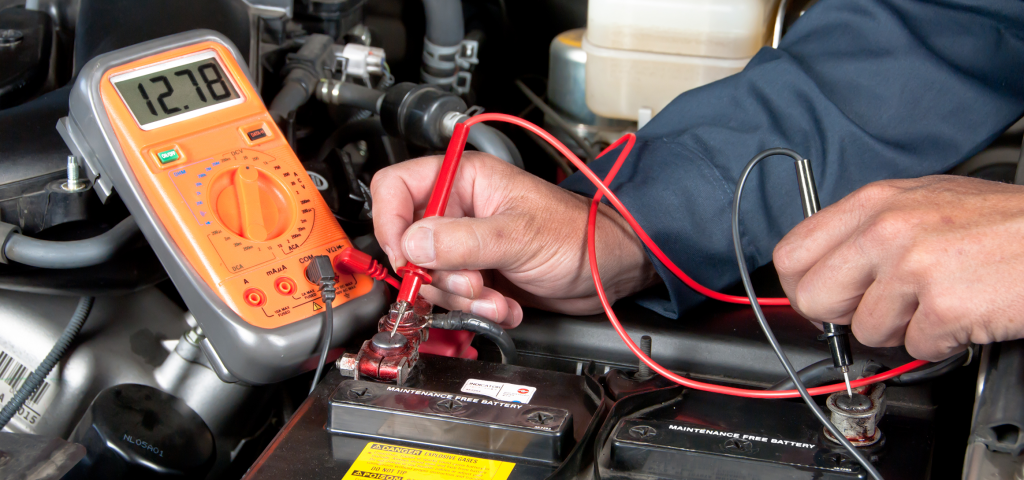
Most cars use what everyone calls a 12-volt battery. Sitting fully charged with the engine off, it is usually a bit above that. Around 12.6 is the number people like to see.
Drop closer to 12.2 and the battery may still start the car, but it is not exactly flexing. Go lower and cold mornings get interesting. Not fun interesting. More like late-for-work interesting.
Running Voltage Tells On The Charging System
Once the engine is running, the alternator should bring the number up. Many vehicles sit somewhere in the 13-to-14-volt range while charging.
Too low and the battery may not be getting fed. Too high and the electrical system may be getting bullied. Neither one is something to ignore for long.
A Good Number Can Still Lie A Little
Here is the annoying part: a battery can show a decent number and still fall on its face when it has to crank the engine.
That is why a real check may include a load test, cables, terminals, charging output, and a quick look for anything draining power while the car sits. Corrosion on a terminal can cause more drama than it has any right to.
Test It Before It Leaves You Stuck
If the car cranks slow, needs jumps, shows battery lights, or acts weird electrically, get it checked before you are begging a stranger for jumper cables in a parking lot.
Call Scotty’s Automotive in Sussex County, NJ at (845) 720-3584. We can test the battery and charging system, explain what the voltage means, and help keep your car starting like it should.
Share:
- Share on Facebook (Opens in new window) Facebook
- Share on X (Opens in new window) X
- Share on LinkedIn (Opens in new window) LinkedIn
- Share on Pinterest (Opens in new window) Pinterest
- Share on Threads (Opens in new window) Threads
- Share on Nextdoor (Opens in new window) Nextdoor
- Share on Reddit (Opens in new window) Reddit
- Share on Bluesky (Opens in new window) Bluesky
- Share on WhatsApp (Opens in new window) WhatsApp
- Share on Telegram (Opens in new window) Telegram
- Email a link to a friend (Opens in new window) Email